A collection of vintage photos of Camp Crowell/Hilaka, provided by council historian Sunny Baddour, is now on line at http://www.flickr.com/photos/65282355@N00/sets/72157626948137609/ . In reply to the announcement of this link on the Friends of Crowell/Hilaka mailing list, Kathleen Bradley wrote:
"I notice the trees on the dam got quite big in some years- not allowed anymore of course for safety reasons. The lake seems much lower in many of the pictures, too. Most of the girls in the photos seemed older. Do you think they were all campers or were some counselors?"
Lynn replies:
I don't know - that's part of the fun of looking at these- the more you look, the more you notice, and then the more you question. It's like working a puzzle!
I showed the series of Kirby House gardens to a friend who is very familiar with the camp. After he stared at them a while, and flipping back & forth between them, he pointed out that the one with the woman standing on the right was taken much later than the other three.
How can he tell? There is a small room added onto the back of Kirby House that isn't in the other, and that reeds have grown up in the middle of the pond.
Does this make a difference to anything? Probably not --- but the act of figuring it out - that's fun! And I bet this kind of landscape forensics would be intersting to girls if presented correctly. MOst of the time when I camped there with troops we were so busy with our planned activities, the kapers, the sight-seeing to obvious places, that we never thought to look. But I bet there is a tremendous amount of history / mystery there, Mostly on the south, but probably some lurking in the woods of the north.
This spring, Suzanne Czaplicki found and pointed out the remnants of garden architecure behind North House: If you stand at the fire circle with the porch to your right, there is an almost hidden path on the left that goes down to the water. A small creek feeds into the lake . there are stone foundations on either side of the creek: there had been a bridge there at one time. It must have been mostly decorative -- You can hop over the creek - but imagine the elegant & myserious Mrs. Neal strolling along this garden path. I keep thinking that there had to be a boat landing around there somewhere.
Suzanne also noticed that upstream of the creek is a bridge that is still there! It goes over a culvert & connects North House lawn with the back of Spiff's Garden. I have been told that the site of Spiff's Garden was, at one time, a clay tennis court. The owner builder of Amity was the son of the owner/ builder of NOrth. If so -the tennis court was right in the middle for both sets of families to use. Makes sense - as does the size & shape of the Garden.
My current lanscape archeology pursuit concerns the possible existence of an ice house on the south side. ONe of the things in the GSNEO history committee archives was a report that a girl wrote about the camp that meantioned an ice house. It's also on a map. I can't remember if the girl drew the map or if the map was separate. Anyway. Both seem to indicate that the Nature Hut that hangs off the side f the hill was it. Which can't be right.
First, for those not familiar with an ice house It's where people got blocks of ice in summer before freezers were invented. It got filled during the winter when slabs of ice would be cut from a nearby pond. The sides of the ice house were heavily insulated. As layers of ice were stored, layers on more insulating material ( like sawdust) would be packed around them. and between the layers.
OK, so we got the pond. We know that Kirby had electricty early on, but the rest of Richfield did not. Kirby did not need the income from an ice business, but it might have been something he worked out with a neighbor. ( He also didn't need the income from a farm, but he had one anyway). However : Ice is Heavy. No one is going to haul it up a hill. Also , the way the Nature hut hangs off the side ofthe hill, it is hardly insulated.
But - just below the nature hut is a garage. The garage is set back INTO the hill and is on a level withthe road which runs right alongside the pond. PLus, if you look at pictures of Kirby house, you can see that there used to be a garage underneath the back porch kinda by the giant oak tree. You can look at the pattern of the brickwork and see that the original garage door opening was bricked in ( just like the one at Coach House).
THEORY ( ok, really hypothesis) The original garage was the garage; and the current garage was originally an ice house. This still does not explain the nature hut. Laura G says she was told it was a house for a worker. Couldn't have been Kirby's main farme manager, because that person lived in the Oviatt Farm house. But it was something before it was a nature hut. It's sitting there right in the middle of one of those vintage pictures. Hmmmmmmmmmmmm..................
Sunday, July 3, 2011

Tuesday, May 17, 2011
Memories of Mable Smith
Kerrin Winter-Churchill contributed this memory of Mable Smith, for whom a shelter at Camp Crowell/Hilaka is named:
My mother went to work for the Cleveland Girl Scout Council in 1949. Like all Girl Scout staffers of the day, she went to Camp Macey, in upstate New York for a month of intensive training. When she came back to Cleveland, she shared an office with Mable Smith. Mrs. Smith was not a volunteer. She was a paid, professional employee of the Cleveland Girl Scout Council, which officiated over Chagrin, Bedford, Richfield, Elyria, and those districts in the Westpark area. My mother was a Field Director.
Mable was the Director of Camps. It was she that scheduled troops at the various campgrounds. She met regularly with the staff that trained the leaders. It was a different world back then. Imagine: every single person who worked at the Girl Scouts had to go through training at a special camp up in New York. Another of Mable's responsibilities was to take the staff out on nature hikes. They would go out with "A stick and a bundle" (which was also the name of the instructional booklet that Mable and my mother wrote and published) to teach about wildflowers and medicinal plants. Other hikes would be all about identifying animal footprints and wild birds. Mom said that so many people would want to go on these walks that they would have to schedule additional days.
I have learned so much about nature from my mother, always identifying plants and birds. My mom told me tonight that Mable taught her so much about this. So it has been handed down to me, and to my sister's children, and beyond. I am sure there are hundreds of other families handing down Mable Smith's legacy in the very same way.


couple extra girls for a long weekend of primitive camping in the
Mohican Wilderness. They had all been studying a manual on primitive
camping and this weekend was to prove to themselves they could
survive by roughing it, if they really had to. They set snares for
food, dug their own latrines, learned to sterilize water by fire -
speaking of fire, they learned how to make it without a match. Mom
said they "had a wonderful time."

Helen Tolman Murray and Lois Schmotzer (later Smith) Field Director
of Chagrin, Elyria and West Park Districts.

Lois Smith) at Mable's home in North Royalton a year before Mrs.
Smith died of cancer.
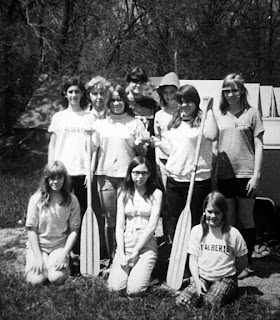
state Canoe racing champions of Ohio Girlscouts in 1974 .
Lynn Geragach, Lucille Manica, Cindy Platt, Jan Carter (brunnette)
Doctor Susan Schuckert, (Susie), Kristin Smith (Sullivan) and Mary
O'Neill.
My mother went to work for the Cleveland Girl Scout Council in 1949. Like all Girl Scout staffers of the day, she went to Camp Macey, in upstate New York for a month of intensive training. When she came back to Cleveland, she shared an office with Mable Smith. Mrs. Smith was not a volunteer. She was a paid, professional employee of the Cleveland Girl Scout Council, which officiated over Chagrin, Bedford, Richfield, Elyria, and those districts in the Westpark area. My mother was a Field Director.
Mable was the Director of Camps. It was she that scheduled troops at the various campgrounds. She met regularly with the staff that trained the leaders. It was a different world back then. Imagine: every single person who worked at the Girl Scouts had to go through training at a special camp up in New York. Another of Mable's responsibilities was to take the staff out on nature hikes. They would go out with "A stick and a bundle" (which was also the name of the instructional booklet that Mable and my mother wrote and published) to teach about wildflowers and medicinal plants. Other hikes would be all about identifying animal footprints and wild birds. Mom said that so many people would want to go on these walks that they would have to schedule additional days.
I have learned so much about nature from my mother, always identifying plants and birds. My mom told me tonight that Mable taught her so much about this. So it has been handed down to me, and to my sister's children, and beyond. I am sure there are hundreds of other families handing down Mable Smith's legacy in the very same way.

Second from Left, my Grandmother, Berta Phanholzer-Schmoter playing
in Rocky River with her fellow "Campfire Girls" in 1919... by this
time, the Campfire Girls and other such organizations were taken
under the wing of what was called "The Cleveland Girls' Council."

1951, My mother's fellow Cleveland Girl Scout Council staffers - from
left to right, Gene "Billy" Hill, visiting GS from South Africa,
Sammie Green, Director of Public Relations for the Cleveland Girl
Scout Council and Virginia Payne-Wentworth, Director of Leadership
Training (left GS in 1958 to pursue a career as noted children's
author.) Note from Lynn: I believe that this picture is taken on the road north of Kirby House. That would be the roof of Cricket's Corner on the right, the Kirby garage on the background.

In 1950, Mable and my mother rented a rustic limo, filled it with
supplies, hooked a trailer with more supplies and set off with a couple extra girls for a long weekend of primitive camping in the
Mohican Wilderness. They had all been studying a manual on primitive
camping and this weekend was to prove to themselves they could
survive by roughing it, if they really had to. They set snares for
food, dug their own latrines, learned to sterilize water by fire -
speaking of fire, they learned how to make it without a match. Mom
said they "had a wonderful time."

From Left to right "unknown", Field Director, "Little Lois
Smith" , Executive Director of the Cleveland Girl Scout Council, Helen Tolman Murray and Lois Schmotzer (later Smith) Field Director
of Chagrin, Elyria and West Park Districts.

Mable Smith at far left of camera - (older glasses and plaid jacket)
and the rest of the Cleveland Girl Scout Council - taken by my mother Lois Smith) at Mable's home in North Royalton a year before Mrs.
Smith died of cancer.

My core Girl Scout troop, Troop 180 - led by our wonderful leader,
the late, Mrs. Lucille Manica and Mrs. Lois Schmotzer Smith - we were state Canoe racing champions of Ohio Girlscouts in 1974 .
Kneeling, first row - left to right, Kerrin Smith (now Winter
Churchill) Linda Dyson and Denise Besida. Standing, left to right, Lynn Geragach, Lucille Manica, Cindy Platt, Jan Carter (brunnette)
Doctor Susan Schuckert, (Susie), Kristin Smith (Sullivan) and Mary
O'Neill.
Sunday, April 24, 2011
Julia Crowell's Husband
There is very little information available on line or at sources such as the Western Reserve Historical Society about Julia Crowell, after whom the south half of Camp Crowell/Hilaka was named. But there is a lot about her husband, Benedict. Benedict Crowell was in charge of miliary procurement during World War I. That meant that he coordinated the entire American effort to manufacture and transport all of the materiel used by the American forces in that war! After the war, he wrote extensively about how he did it, and about how the US armed forces should prepare themselves forthe next conflict. And during World War II, while he did not have an official position that we know of, he was a close advisor to Secretary of War Henry Stimson.
Below are a speech and two articles found in the Western Reserve Historical Society archives. The speech and one article are biographical, and the other article was written by Benedict Crowell in 1921 about "Modern Preparedness". You can click on an image to display it sized to fit on your screen, and then click on it again to display it in its original size, where you will be able to read the text more easily.


Below are a speech and two articles found in the Western Reserve Historical Society archives. The speech and one article are biographical, and the other article was written by Benedict Crowell in 1921 about "Modern Preparedness". You can click on an image to display it sized to fit on your screen, and then click on it again to display it in its original size, where you will be able to read the text more easily.


Saturday, April 9, 2011
Jim Kirby's letter
One of the things in the Mother Lode was a letter from Jim Kirby to the Girl Scouts describing what they had purchased, and how to take care of it. Here it is:


The Mother Lode
A box recently arrived at the GSNEO History Committee office. Sunny took one look , saw what was in there, and gave me a call.
Where it has been all these years? She says they didn't have all this information available to them when they wrote "A Promise Kept" - but hey - better late than never!
I couldn't resist immediately sharing the letter from James Kirby himself! Some of the information is not new - but I never had a source to really confirm. I like that Kirby capitalized the names of trees! I like that he called his workshop " the power house" . I especially am happy to hear how sturdy the dam is!!!!!!!
The most surprising thing to me is that when the Girl Scouts bought the property, the mechanism for the self-clarifying lake was still operating!!! I wonder if the old council ever realised what a unique structure this was & tried to maintain it? I wonder if anyone ever took care of the ballbearings in the millwheel per Kirby's instructions?
Stuff I want to find out more about - evidently there was some sort of farming operation still going on. a chicken coop? extra barns? whooa! what's up with those? I'm more pumped than ever to do some archeology!!!
Next up: the official description of the land when the council was getting ready to buy it, the campaign to raise the money , old maps. Tons of stuff about the early council. Poor Sunny had to pry my hands off the xerox machine and drag me screaming out the door. She promises to let me back in if I promise to behave.
Some of it I will summarize instead of repeating everything - but Rob has agrred to scan everything so it can be posted on the history blog!
Lynn
Thursday, April 7, 2011
Celebrity Endorsements
Purchase of the Kirby estate to be a Girl Scout camp was SPECIFICALLY endorsed by:
Those of you who have run programs at camp about solving mysteries, Crime Scene Investigation, etc - you were more appropriate than you knew. Elliot Ness was the saftey director of Cleveland. He noted that there was much less juvenile crime in areas where there were organized Girl Scout troops. He supported the purchase of this camp!!!!!
Here's the introduction of "Elliot Ness: The Man Behind the Myth", a biography written by Marilyn Bardsley:
comment from Corey :
this is completely not related...but I'm currently working with the materials from Al Capone's hide out to add detail to my professor's home...after the hide out was shot out during their stand off, my professor's professor gutted it for architectural remnants...all his detailed windows and doors are in my professor's garage and he's asking a few students to hang the elements around his house...
...Lucy, this is the contemporary history professor I was telling you about that specializes in mid-century modern and design in America between the wars...
comment from Lynn:
the wife of this proffessor donated her hand-stiched 1960's senior GS uniform to the Richfield Historical Society
- Eleanor Roosevelt, wife of President Franklin Roosevelt
- Lou Henry Hoover, wife of former President Herbert Hoover
- Eliot Ness, crimefighter
"I was very much interested to hear whatthe Cleveland Girl Scouts are planning to do, and I wish them every success in their campaign for funds with which to buy a camp site. I think camps for girls are very valuable and are greatly needed."
Those of you who have run programs at camp about solving mysteries, Crime Scene Investigation, etc - you were more appropriate than you knew. Elliot Ness was the saftey director of Cleveland. He noted that there was much less juvenile crime in areas where there were organized Girl Scout troops. He supported the purchase of this camp!!!!!
Here's the introduction of "Elliot Ness: The Man Behind the Myth", a biography written by Marilyn Bardsley:
Ever since Eliot Ness first published The Untouchables in 1957, the public has fallen in love with the adventures of this authentic American hero. His book was a runaway best seller because it was the exciting true story of a brave and honest lawman pitted against the country's most successful gangster, Al Capone. The television series that followed in the 1950's and the Kevin Costner movie in 1987 built fancifully on the same theme. Then again in 1993, the television series has been remade for yet another generation to watch Eliot Ness battle it out again with the Capone Mob.
Every school child knows what Eliot Ness did for two years in Chicago, but what happened to him afterwards when Al Capone went to jail? Almost nobody knows. Does that mean the young hero retired to a quiet life?
Not by a long shot! With a new group of "Untouchables," Eliot Ness went right on fighting the mob for another decade: staging daring raids on bootleggers and illegal gambling joints, catching criminals with his bare hands, and generally putting organized crime on the run. After Capone, he broadened his crusade to include labor racketeers, crooked cops and the country's most vicious serial killer, the Mad Butcher of Kingsbury Run.
So why didn't Eliot Ness write about his adventures after Chicago? Actually, he had planned to do just that, but he died of a heart attack just before the publishing of The Untouchables.
Ness's career in law enforcement continued for a decade beyond the Capone years, a decade in which his very considerable talents flowered. At the age of 33 in Cleveland, he faced the challenge of his career when he took over the corrupt and incompetent police force in a city that had become a haven for gangsters.
Never one to sit behind a desk and administrate, Eliot took to the street with a new group of trusted confidants, mostly undercover investigators and reporters, until he cleaned up the police force and put the mob chieftains behind bars.
Drawing on his master's degree in criminology, he turned the miserable Cleveland police force into one of the most modern, efficient and respected departments in the world. Crime in the city dropped 38 percent after he was on the job just a couple of years!
Eliot Ness was so much more than just the courageous guy who battered down the door of Capone's biggest brewery. It's time the American public knew about the rest of his accomplishments, which are at once exciting, inspiring and long lasting.
comment from Corey :
this is completely not related...but I'm currently working with the materials from Al Capone's hide out to add detail to my professor's home...after the hide out was shot out during their stand off, my professor's professor gutted it for architectural remnants...all his detailed windows and doors are in my professor's garage and he's asking a few students to hang the elements around his house...
...Lucy, this is the contemporary history professor I was telling you about that specializes in mid-century modern and design in America between the wars...
comment from Lynn:
the wife of this proffessor donated her hand-stiched 1960's senior GS uniform to the Richfield Historical Society
Sunday, January 30, 2011
History's Jigsaw Puzzle
Tracking down an unwritten history is like working a jigsaw puzzle - where all the pieces are playing hide-n-seek. Spent the morning at RHS. No particular objective. I have come to realize that in this small town where everything and everyone is connected to everything and everyone else, I might as well just go through and read everything.

Adeline Axtell ( who owned the driveway parcel) continues to be a mystery - altho there was plenty about her husband - the governer of the New Mexico territory - in the Cleveland Leader, November 5, 1878. After a lengthy tale of Axtell's western adventures, there is a final paragrph referring obliquly to the Oviatts. Then this: "One place of interest, which deserves more than a passing notice, is located at the foot of the hill upon which the West village is built. It is the cider mill, where the average Richfielder imbibes enthusiasm and patriotism. In proportion as the texture of the cider approaches that of a grindstone, the Richfield citizen becomes more patriotic. Much more might be written of this place, but lack of space and a great love of my fellow man bid me forbear."
The foot of the hill would be at Oviatt & 303, by the south entrance of camp. The cider press could have been across the street where the golf course is now - but there's that odd, unconnected reference to the Oviatts. So at first I thought this was a nice little mention of a place to get apple cider. But the more LInda and I talked about it, it feels like an "insider's" code. Kind of the way gossip columns used to hint at scandals without actually making an accusation. Maybe that last line is kind of a threat.
We know there was a sawmill behind the Oviatt farm house in 1834. Which mysteriously (and frustratingly) disappeared from the town records. Did they turn it into a cider mill - as in hard cider? The more the citizens drink, the more patriotic they become - as in generally more emotional? Hmmmmmmm. Well, it's a theory. But if these guys were running an unofficial tavern - maybe that will turn up in the archeology!
As usual, anytime anyone came in, Linda asked if they had any connection with the Girl Scout camp. Turns out that the reason Ed came in was to purchase on of the wooden millwheels from Green Cottage crafters that RHS still had on hand. It further turns out that Ed is one of our camp neighbors whose property adjoins Crowell HIlaka! We had a good time talking history & the need for kids to get out into nature.
Next - up to the Kirby Company on W. 114th to look through the last box of their archives. Most of the archives had been lost or destroyed and there is almost nothing left. The staff were very friendly and they set me up in a quiet room with a good cup of coffee. Tucked in between all the 1970's photos was three versions of this old picture:
There is no label, no name. The only context is that it was in the box of company photos. So its likely a group of employees. 1920's, early 30's? The guy in the front row 4th from the left in bow tie & jacket looks like it could be Kirby, and I would suspect a couple of the other front row bow tie guys are Scott & Fetzer, Kirby's business associates. I like to imagine that this is at camp. On the dam hill. We know that the Kirby Co held at least one picnic on camp land. But if that's a shadow of Kirby House on the far left, the giant oak tree is missing. Altho maybe it can't be seen from this angle. Or maybe this is a completly generic, insignificant hillside nowhere near the camp.
Not only are the jigsaw puzzle pieces hiding, but pieces from other puzzles are mixed in at random.
sigh. :-(
sigh. :-(
Lynn
Subscribe to:
Posts (Atom)